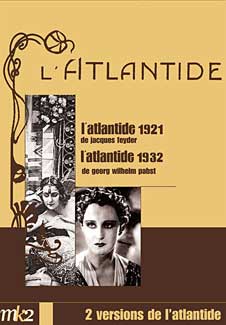
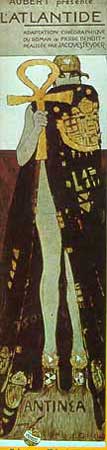
 The French silent film L'Atlantide or Lost Atlantis (1921) was based on an internationally best-selling Lost Race novel by Pierre Benoit, L'Atlantide (1919). It starred the elegant, Mercury-androgynous & slightly chubby classic vamp, Stacia Napierkowska (from the classic French serial Les Vampires, 1915) portraying the Atlantean queen Antinea.
The last vestige of Atlantis is a subterranean city in the French Sahara. It was discovered by legionnaires Captain Morhange (Jean Angelo) & Lieutenant de Saint-Avit (Georges Melchior).
The story opens with legionaire Saint-Avit returning half-mad from across the desert, grieving the loss of his friend Morhange. He is sent to a hospital where he periodically speaks as in a delirium of the events in the desert.
He convelesses a long while before returning to Paris. Memories or dreams keep surfacing, of an insane adventure. He rejoins the Foreign Legion & goes to a frontier outpost in the Saraha. Two years have passed, during which time the desert continously called to him.
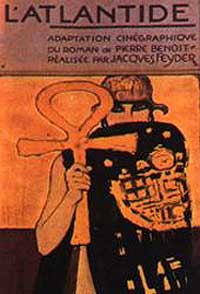 His friend Ferr wishes to go with him, but Saint-Avit insists, "This time, I am going alone." For the first time, he confesses he killed Morhange, & begins to tell his old classmate what really happened two years earlier. Here the flashbacks begin. His friend Ferr wishes to go with him, but Saint-Avit insists, "This time, I am going alone." For the first time, he confesses he killed Morhange, & begins to tell his old classmate what really happened two years earlier. Here the flashbacks begin.
Beautiful desert & mountain photography (filmed at considerable expense in Algeria) illuminates the journey of Mohange & Saint-Avit as they are led by a mysterious bedoine people through uncharted regions of the Haggar Mountains & into caverns where the Arab promised Greek inscriptions could be found.
[SPOILERS ALERT] Drugged by herbal fumes of hashish which the Arab put in their campfire, when Morhange & Saint-Avit awaken from their stupor, they're in an underground world, the center of which is a jungle crater open to the sky with encircling cliffs impossible to scale. Our legionaires are certainly trapped.
The desert adventure had been fairly good stuff even without the eventual fantasy events, which takes about an hour to begin. The rest of the film will be the slowly paced fantasy of the remote subterranean Atlantis.
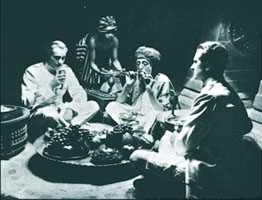 Its pseudo-Greek & art nouveau sets with Aztec to Egyptian to Black African to Ottoman borrowings, are stupendously cool, & intend to convey the idea that all these far-flung cultures were offshoots of Atlantis. Its pseudo-Greek & art nouveau sets with Aztec to Egyptian to Black African to Ottoman borrowings, are stupendously cool, & intend to convey the idea that all these far-flung cultures were offshoots of Atlantis.
They discover the mummy room of Antinea's former consorts before they meet the queen herself. She has some mysterious method of preservation that turns her dead consorts into a statue of gold, a process that apparently extends her own life as much as their lives are shortened.
When at last they meet the mysterious queen, she has a caracol for a pet, instead of the usual cheetah of such films. The vile queen mesmerizes Morhange but prefers Saint-Avit to be the next in her endless line of doomed consorts.
She exerts her mesmeric powers over Saint-Avit, but it is Morhange she prefers for her consort. When Morhange proves immune to her msmerism & her charms, her pride is undone, & for the first time she falls in love.
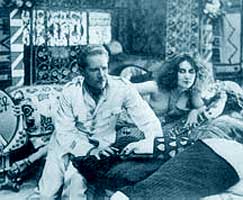
 The queen's handmaiden Tanit (Marie-Louise Iribe) has a crush on Saint-Avit.
She'll eventually help him escape, having revealed to him a long side-story given as a flashback of her former life as Princess of Gao. She was stolen away by raiders who reduced her village to to ruins, & she became Antinea's slave.
Morhange's devotion to his friend & his refusal of Antinea's advances causes her to use her power over Saint-Avit to induce him to murder Morhange.
When Saint-Avit realizes what Antinea has been able to make him, he is horrified by himself, & by her, & is thus sufficiently outside her control that he can at least perceive of escape.
Tanit leads him out from the hidden world, while Antinea wails in grief for Morhange, sorry for what she has done.
 Tanit & Saint-Avit's cruel treck across the desert & her death pursing a mirage provides the final act of the adventure. Tanit & Saint-Avit's cruel treck across the desert & her death pursing a mirage provides the final act of the adventure.
The story has by then been told to Ferr & now it's time for Saint-Avit's return to Antinea, who haunts him always. And the three-fingered Arab arrives at last to serve as his guide. [END SPOILERS ALERT]
An epic that rewards patience, the complete version reaches 212 minutes. Belgium-born director Jacques Feyder was part of a movement of "poetic realists" in the French cinema, with L'Atlantide, the first notable film of the poetic-realist movement. The movement lasted until about Word War II & its best-remembered exponents were Jean Renoir & Marcel Carne.
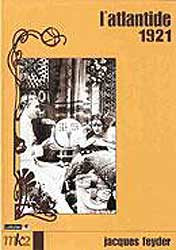
Feyder's epic is included as an extra on the French dvd release of P. W. Pabst's film based on the same novel, The Mistress of Atlantis (L'Atlantide, 1932). For English language viewers it can be had on a three Feyder dvd collection, together with Faces of Children (Visages d'enfants, 1925) & a film version of Anatole France's tale, Crainquebille (1922).
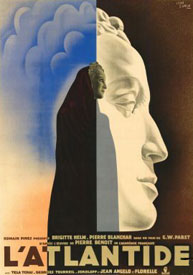 Between 1921 & 1991 Pierre Benoit's novel would be filmed nine times inclusive of telefilms. The second version, directed by Georg Wilhelm Pabst, remains most compelling. Between 1921 & 1991 Pierre Benoit's novel would be filmed nine times inclusive of telefilms. The second version, directed by Georg Wilhelm Pabst, remains most compelling.
Beautifully shot in black & white in the Haggar Desert in North Africa, The Mistress of Atlantis (1932) was filmed simultaneously in English, French & German. The English version survived as a single archive print & was for many years unavailable, finally released on DVD by Turner Classics.
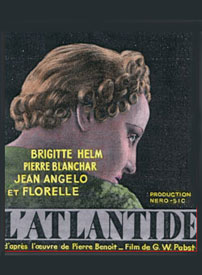 Captain Jean Morhange (Gibb McLaughlan) & Lieutenant Andre de Saint-Avit (John Stuart) are French Legionnaires sent by the war office to feel out the attitudes of desert tribes. They head off on a camel journey & find an entire mountain range lacking on maps. Captain Jean Morhange (Gibb McLaughlan) & Lieutenant Andre de Saint-Avit (John Stuart) are French Legionnaires sent by the war office to feel out the attitudes of desert tribes. They head off on a camel journey & find an entire mountain range lacking on maps.
They soon realize the stories of a desert Atlantis sunk beneath the sands could well be true, given the enormity of this vast uncharted region.
After numerous rugged adventures among the bedouins & in a frontier Arab city, Saint-Avit & Morhange are eventually taken into catacombs & greeted by Count Velovsky (Gibb McLaughlin), who has dwelt in this buried Atlantis for over twenty years.
Ivar Torstenson (Mathias Wieman), another European trapped in Atlantis, is gloomy & kif addicted, rather insanely in love with the rarely glimpsed Queen Antinea (Brigitte Helm, best remembered as the beautiful robot in Fritz Lang's Metropolis). He warns the new arrivals, "You'll end up just like me," before committing suicide.
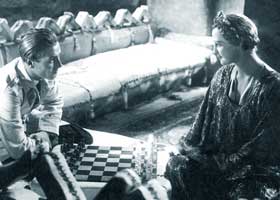 Queen Antinea has the bold aquiline profile of a Barrymore, a startling art deco beauty with a pet cheta. She keeps a collection of mummies, which are all her past lovers. Queen Antinea has the bold aquiline profile of a Barrymore, a startling art deco beauty with a pet cheta. She keeps a collection of mummies, which are all her past lovers.
Saint-Avit becomes obsessed with Antinea, as she seems to have that power over most men. The exception appears to be Morhange, immune to her charms. Since she cannot seduce him with ease, she becomes fascinated for the first time with a man she cannot mesmerize.
Spurned Antinea eventually commands Saint-Avit to murder his own best friend, & only then is her spell over him broken, when he realizes what she has made him do.
A bedouin girl enslaved in Atlantis has grown fond of Saint-Avit & reveals the secret route out of the buried city. The last important sequence is the agonizing journey back across the burning thye burning Sahara.
This is quite a beautiful film really, transcending a pulpy premise to convey a atmospheric exoticism.
copyright © by Paghat the Ratgirl
|