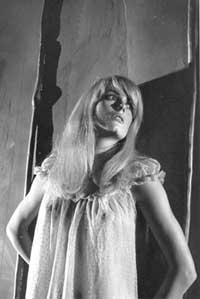
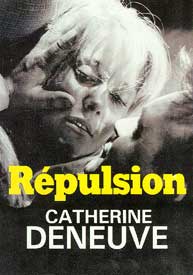
 Catherine Deneuve is Carole in Roman Polanski's classic tale of Repulsion (1965). Carole is a sexually suppressed virgin whose great beauty gains her unwanted attentions that drive her first into paranoia & finally into psychosis. Catherine Deneuve is Carole in Roman Polanski's classic tale of Repulsion (1965). Carole is a sexually suppressed virgin whose great beauty gains her unwanted attentions that drive her first into paranoia & finally into psychosis.
Claustrophic when she hides away in her apartment watching the cracks of the ceiling & walls widen, agoraphobic if she goes outside, Carole has no path that does not result in terror.
Repulsion was long the favorite film of a friend of mine who upon noting a revival at the local art cinema called up her dad & assured him he'd love to see it because he was also a fan of thrillers. She picked him up & off they went to the cinema.
Afterward he was exceedingly quiet & disturbed by what he'd seen, & finally asked, "Why did you want me to see this?" He had responded to the film as an accusation.
She was quite surprised her dad didn't like it let alone thought it was intended as some kind of criticism of his own inner being. It was her first inkling that Repulsion despite having curdled out of Roman Polanski's twisted imagination was perhaps more a film for women than for men.
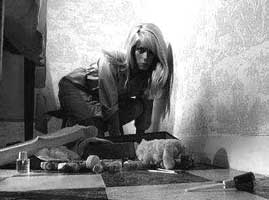 On some level Replusion does seem to be a "reverse slasher" & changes the nature & meaning of the terrified/victimized female in, say, the films of Dario Argento. On some level Replusion does seem to be a "reverse slasher" & changes the nature & meaning of the terrified/victimized female in, say, the films of Dario Argento.
As Carole walks through the city streets & lascivious men try to catch her attention at every turn, this is not paranoic; this is what women really do live with every day.
Men's threatening use of sexual attention is not restricted to tongue-lolling come-here-baby & whistles at women as beautiful as Deneuve. Even cross-eyed chubsters & wrinkled old grannies end up on the rosters of rape victims.
So the world that drives Carole to insanity is not a world restricted to her mind. It is, rather, the actual world for which she is less capable than are most women at coping & adjusting.
On one level the central character's madness is almost revolutionary, though on the main level Carole surely needed to be on medication. Having long been one of my own favorite films, the margins between insanity & justified fear in a world that really does assault women in a myriad overt & subtle ways makes it seem almost a feminist story, even if brutal & unsettling.
It is the equivalent of Charlotte Perkins Gilman's classic short story "The Yellow Wallpaper" with its dishevelled madwoman crawling about the edges of her room, having come to this position due in large part to her cultural environment.
As a footnote, a low budget film called Haunts (1977) superficially imitates Polanski's extraordinary Repulsion, right down to the physical appearance of the protagonist.
copyright © by Paghat the Ratgirl
|