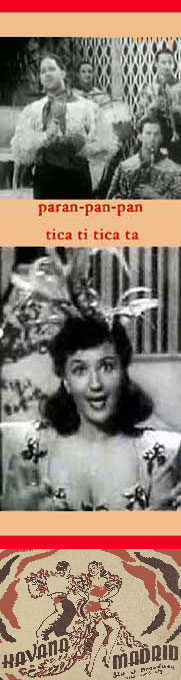
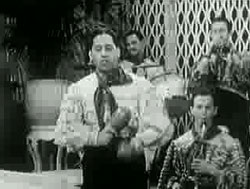
 Maya's Pan-American Orchestra put on a big band song & Carribean chorus line number in The Havana-Madrid Show: Paran-Pan-Pan (1941).
The title card identifies this as "Maya's" orchestra; when performing elsewhere than the Havana-Madrid Niteclub, this would be Froilan Maya's y su Orchestra Cubana; aka, Maya & His Rhumba Ambassadors; aka, Los Diplomalticos. "Paran-Pan-Pan" had been a hit for the Froilan Maya Cuban Orchestra in 1938.
The singer who in this soundie looks like he's leading the band with maracas is Nano Rodrigo, who would later over the Havana-Madrid club's floor show. Nano does his number "Paran-Pan-Pan" in Spanish while shaking the maracas & moving in time with the choras line of gals. Then out come the star dancers, Carlos & Zedra.
Though it's impossible to see why, this was one of the soundies censored in a four states for presumed moral reasons. Too much spicy Spanish senorita shimmying from the chorus girls, or Zedra's extremely long legs glimpsed through the front of her floor-length but open-fronted feathery skirt.
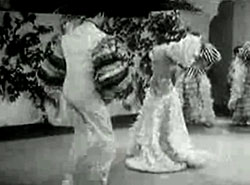 There's a version of this soundie at web-video sites, derived from the Prelinger collection at archive.org, which is attached with a second soundie without identifying it as a completely different soundie, making it look like part of the Havana-Madrid Show. There's a version of this soundie at web-video sites, derived from the Prelinger collection at archive.org, which is attached with a second soundie without identifying it as a completely different soundie, making it look like part of the Havana-Madrid Show.
This was from a home movie reel distributed by Official Films, called Hollywood Funtime! (1947), without regard for the fact that the Havana-Madrid niteclub was in New York, not Hollywood. A voice-over announcer (Frank Gallup) quite clearly says the show is from "the great white way," meaning Broadway, but Official Films' packing editor just wasn't paying attention.
In any case, that second soundie is actually Cuban Pete (1942) & that's Luba Malina singing alongside Noro Morales at the piano.
The two films fit together not only for their shared Latin Beat but because Karlos & Zedra show up in Cuban Pete as well as in Paran-Pan-Pan. Official Films sold their one-reeler soundie shows three soundies per reel, so there must've been a third act on the Hollywood Funtime! reel, but I've not discovered which that would be.
Maya's Pan-American Orchestra made several soundies in 1941, capturing different elements of the floor-show at New York's Havana-Madrid Nightclub. The Havana Madrid Show: Mamae eu quero & The Havana Madrid Show: Bahiana both feature trilling squeaky singer Yola Galli, & The Havana Madrid Show: La Comparsa, this last a Latin American standard by Cuban composer Ernesto Lecuona, & also included in the Castle Films three-part home-movie Tropical Serenaders (1946).
Mamae eu quero was included as one-third of the Official Films home-movie Latin Tempos (1946) the other two soundies being Frenesi (1941) featuring Carlos Fernando & His Mexican Orchestra with Anita Camargo & Theodore Rand; & Conga Loca (1941) featuring Nano Rodrigo & His Orchestra.
Besides La Camporsa, the other two soundies in Tropical Serenaders are Rita Rio in a big production number with Carlos Fernando & His Mexican Orchestra, Adios (1941) featuring also Allan Baldwin; & Will Bradley & His Band with Billie Joyce singing the title number Amor (1944), glammed up with help from the Mildred Ray Dancers.
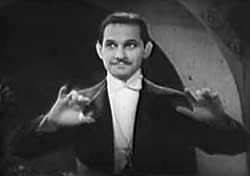 The Nano Rodgrigo Orchestra appears in Aparicon (1941) with Mexican-born singer & Spanish language film star Ramon Armengod.
The dinner club setting has Ramon seated at a table with a beautiful date, singing the title song to her in Spanish, with Nano & his orchestra in the far background.
At the instrumental break, Ramon & his gal dance in close embrace, with other couples also on the floor.
There was, however, an even more beautiful woman with a man at the next table. Ramon returns his date to their table & then asks the gentleman if he can dance with his date, being permitted. He makes it back to his own date, however, in time to look apologetic at the end of the final verse.
It's a pleasant little soundie that involves the viewer in Ramon's ill-balanced traits as romanticist & horndog.
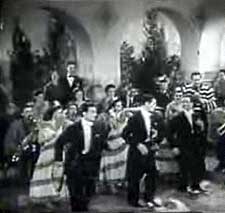 Mi Rhumba (1941) again features Nano Rodrigo & His Orchestera. Rodrigo is one handsome s.o.b. shaking his maracas instead of a band leader's wand. Mi Rhumba (1941) again features Nano Rodrigo & His Orchestera. Rodrigo is one handsome s.o.b. shaking his maracas instead of a band leader's wand.
Three rhumba dance couples are headed by "Lola & Andre" who also dance in a couple of Joe Sodja soundies in 1944, besides Nino Rodrigo's soundie Conga Loca.
The two dancers keep the pictorial element of Mi Rhumba lively as the orchestra plays the instrumental, & Nano never stops shaking those maracas.
Mi Rhumba became one-third of the Official Films home-movie Rhumba Serenade (1946), the title number from 1941, reviewed immediately below, having been an instrumental by Fredrick Feher & the Mills Rhumba Orchestra, for the dance team "Nico & Charisse."
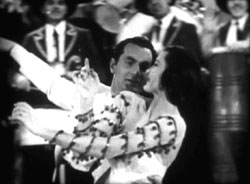 The Mills Rhumba Orchestra was concocted by Frederik Feher, who ran a little corner of the soundies productions all his own on the west coast. His soundies tended toward more classical attitudes & expressions. The Mills Rhumba Orchestra was concocted by Frederik Feher, who ran a little corner of the soundies productions all his own on the west coast. His soundies tended toward more classical attitudes & expressions.
His band members are all decked out like Spanish cabelleros, with great marimba opening then piping trumpet & a wonderful vocalist not doing lyrics, but providing joyful musical shouts with upraised arms.
Feher really had a feel for creating images that were simple but artful, & this is beautiful to look at even before the dancing stars arrive on screen.
The background is very black, & the musicians stand out like bright stars in the darkness, much as in Feher's greatest soundie A Jazz Etude (1941).
Then in come Nico Ford & Cyd Charisse for a fine little performance half rhumba, half flamenco, very showy, prancy, & pretty. This is one of the great "dancie" soundies.
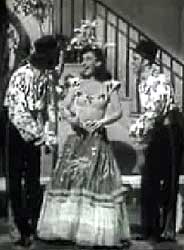 The ten-minute home-movie version of Rhumba Serenade included the title soundie, together with Nano Rodrigo's Mi Rhumba, & a third soundie, Ginger Harmon in Tica Ti Tica Ta (1942).
Along with Ginger Harmon in the trivial novelty number Tica Ti Tica Ta are the Mercer Brothers, Bud & Tim.
The ten-minute home-movie version of Rhumba Serenade included the title soundie, together with Nano Rodrigo's Mi Rhumba, & a third soundie, Ginger Harmon in Tica Ti Tica Ta (1942).
Along with Ginger Harmon in the trivial novelty number Tica Ti Tica Ta are the Mercer Brothers, Bud & Tim.
Harmon is kind of unpleasant to look at though her voice is reasonable, wasted on this particular song. It further pretends to have a Latin beat, an offense to Latin beat performers.
Ginger Harmon made nine soundies in 1941 & 1942 but her career had few highlights & she's mostly forgotten now. I can't say that's a big injustice to her talent.
Here she sings between the brother dancers. They are purportedly Latin American boyfriends whose names are too foreign to pronouce or who look too similar for her to tell them apart, so she has renamed them Tica-ti & Tica-ta.
During the instrumental center of the number, the Mercer Brothers decked out in gaucho drag go off & dance together in some other part of the hacienda.
For climax, in comes a conga line of people not previously in the film. In all, it's not just tica ti & tica ta, but it's tacky too.
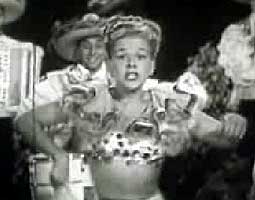 Chi Chi Castenango (1946) begins with Marilyn Hare & The Paragons looking at travel brocheurs as Marilyn sings the ridiculous song which runs "Money money money money money. Who wants money? It ain't hay. It ain't even peanuts." Chi Chi Castenango (1946) begins with Marilyn Hare & The Paragons looking at travel brocheurs as Marilyn sings the ridiculous song which runs "Money money money money money. Who wants money? It ain't hay. It ain't even peanuts."
The lyrics insist there's a place where they can go & get treated like royalty without having any money, namely in Chi Chi Castenango where they do not like money.
As Marilyn starts dancing, suddenly she is dressed up like a blonde Mexican showgirl, with the Paragons in sombreros playing brass behind her as she shakes & wiggles & sings.
There's not a lot to be said for the novelty song "Chi Chi Costenango" but it's a lively little performance with some cute tongue-twister lyrics.
It was also included in the Official Films home-movie with two other soundies, under the title Spicy & Spanish released in 1946, taking its main title from a 1944 soundie. The second soundie of this selection is the Latin-beat band Eddie LeBarron & His Orchestra in Coax Me a Little Bit (1946).
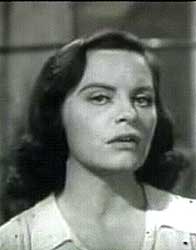 The last & title number of the three is the campy Spicy & Spanish (1944) starring Harry Lefcourt & His Red Jackets, with vocal duet by guitarist "Little Frankie Little" & with accordion, Jeanne Claire, accompanied by the Sande Dancers. The number Jeanne Claire sings is "Say Si Si." The last & title number of the three is the campy Spicy & Spanish (1944) starring Harry Lefcourt & His Red Jackets, with vocal duet by guitarist "Little Frankie Little" & with accordion, Jeanne Claire, accompanied by the Sande Dancers. The number Jeanne Claire sings is "Say Si Si."
Another under-three-minute soundie that wants you to think "Latin" features Gracie Barrie giving the camera a psychotic gaze while singing the titular novelty song Stone Cold Dead in the Market (1946), a cold-blooded comedy number about killing one's husband.
The faux-Latin calipso number is sung in a rustic cafe setting, with a happy dancer spliced in a couple spots. In all, it's a strange enough song to that the soundie's a lot of fun. But a version of the song by Ella Fitzgerald is rightly better known today.
It was recycled into the Official Films home-movie Latin Novelties (1946) together with other campy soundies, Chiquita Banana (1946) featuring the Terry Twins, & Gay Ranchero (1941) featuring Latina commedienne Luba Malina backed up by Noro Morales & His Orchestra.
copyright © by Paghat the Ratgirl
|