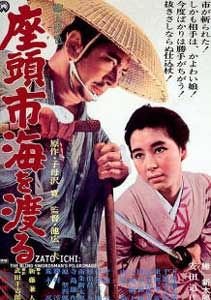
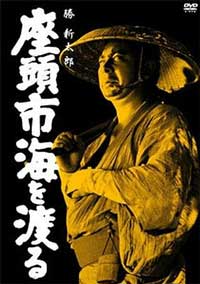
 Shintaro Katsu (1931-1997) was born Toshio Okamura, son of kabuki actor & shamisen player Katsutoji Kineya. Shintaro Katsu (1931-1997) was born Toshio Okamura, son of kabuki actor & shamisen player Katsutoji Kineya.
He became well known throughout Japan by the nickname Katsushin, though some of his closest intimates knew him by his birth name Toshio.
Like his father, he mastered the shamisen (a traditional guitar-like instrument) & had a beautiful singing voice, his enka or folksong recordings becoming top hits. We get samples of his enka singing in a few Zatoichi episodes, & sometimes see him playing shamisen.
As a film producer, Katsushin was responsible for many great films for other actors. Best known in the west would be his productions of the "Lone Wolf with Child" feature films starring his older brother Tomisaburo Wakayama, & two "Lady Snowblood" films starring the exquisite Meiko Kaji.
He loved to party & was a well-beloved figure who would eventually bankrupt himself with his gambling & his soft-touch personality funding the projects of friends & lost causes.
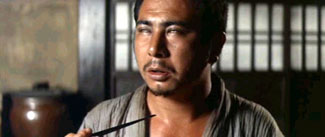 When fellow superstar Kinnosuke Yorozuya returned the love by trying to bail Katsu out of debt, Kinnosuke's production company was dragged down too, with health consequences for the devastated Kinnosuke. When fellow superstar Kinnosuke Yorozuya returned the love by trying to bail Katsu out of debt, Kinnosuke's production company was dragged down too, with health consequences for the devastated Kinnosuke.
So Katsushin's friendship could be a mixed blessing of helpfulness & intense friendship, or drunkenness & ruination.
He was a recipient of "the Japanese Oscar" or Kinema Jumpo Award as best actor, with numerous other awards & honors.
His greatest contribution to cinema will always remain his portrayal of the blind masseur & fast-draw swordsman Zatoichi, whom he played in twenty-six films & four seasons of television episodes each a meritorious mini-movie comparable to the feature films in excellence.
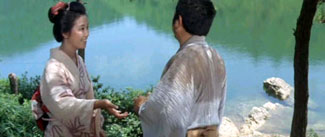 With a script by lefty filmmaker Kaneto Shindo, Zatoichi's Pilgrimage (Zatoichi Umi-o wataru, Daiei, 1966) is a particularly good piece of writing, with a clear good plot riddled with simple but excellent one-liners: "I'm impressed. Great men are in the world, aren't there?" "I'll leave you one arm. Practice hard & try again." "Don't brag about being a pickpocket if you can't do it better." With a script by lefty filmmaker Kaneto Shindo, Zatoichi's Pilgrimage (Zatoichi Umi-o wataru, Daiei, 1966) is a particularly good piece of writing, with a clear good plot riddled with simple but excellent one-liners: "I'm impressed. Great men are in the world, aren't there?" "I'll leave you one arm. Practice hard & try again." "Don't brag about being a pickpocket if you can't do it better."
It's one of the best episodes in the blind swordsman series, with some of the finest support players, including Kunie Tanaka as the loquacious man.
The film has an extremely serious tone. Even the oddest situations are gloomy. After Ichi slays a man named Eigoro (Hisashi Igawa) who attacked him, the dead man's horse finds its owner's corpse, & is upset. The horse begins to follow Ichi, as if for revenge.
Such a thing as that can really haunt Ichi, who is in the midst of an eighty-eight shrine pilgrimage to see if the gods can help him never again have to kill another man (which, of course, they cannot).
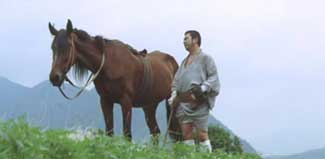 At a crossroad, the horse insinuates itself in such a manner as to demand Ichi go the way the horse wants them both to go. At a crossroad, the horse insinuates itself in such a manner as to demand Ichi go the way the horse wants them both to go.
Guilt ridden, Ichi answers to the horse's whinnying, following it to a certain place. There he meets Eigoro's sister Okichi (Michiyo Ookusu aka Machiyo Yasuda), the embodiment of innocence.
Zatoichi does not dodge her just effort to get revenge, & she ends up having to nurse him back from the edge of death. Girls always fall for Ichi, & Okichi for all her need for revenge is no exception.
Some few viewers who don't quite see the charm of a scruffy fellow like Ichi may find it hard to believe how many leading ladies want him so bad. Personally I get it. And in real life, Katsushin was just such a ladies' man, in an open marriage to actress Tamao Nakamura.
He kept up quite a wild life of boozing, opium use, gambling, & womanizing right into old age, with frequent clashes with the law. He could be a bit gross it's true, but he was a whole lot sexy, & one aspect of that sexiness fuels the charismatic character of Zatoichi.
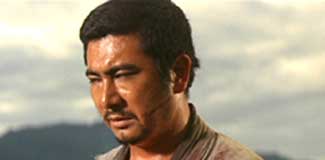 Ichi, as happens in not quite every episode, is drawn into the troubles of the village. Ichi, as happens in not quite every episode, is drawn into the troubles of the village.
A filthy, bullying horse-trading gang (headed up by another great character actor, Isao Yamagata, who could play heroes or villains with equal acumen) has been taking over farm land. Ichi will eventually set out to handle them alone.
The villagers are a mean-spirited lot who aren't at all apt to help Ichi when the chips are down, even though he acts selflessly in their behalf. He has undertaken to train them in some basics of defense, but they want him to risk his life alone, in accordance with the plan of the two-faced headman Gonbei (Masao Mishima).
Even as the excellent one-against-all swordfight choreography unfolds, there's still some small question as to whether the townsmen will find sufficient decency & bravery to leave their houses & help, or whether they will let Ichi face such danger in their behalf without the least assistance.
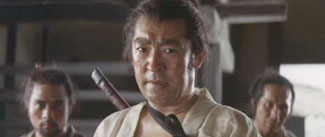 One man does prove brave enough to come out; but he dies at once from an arrow, & no one else so much as peaks out from the shelters until only one bad guy is left standing. One man does prove brave enough to come out; but he dies at once from an arrow, & no one else so much as peaks out from the shelters until only one bad guy is left standing.
Even when Ichi stands wounded from the bad guy's miniature bow, with an arrow through his arm, nobody seems to care if he lives or dies, just so long as his actions benefit the farmers.
A message arises from the film, a simple one, that people are bad. Whether bullying thieves out to do harm, frightened peasants who care about no one but themselves, or a champion like Ichi who inevitably kills even people who have families that loved them -- everyone does bad things.
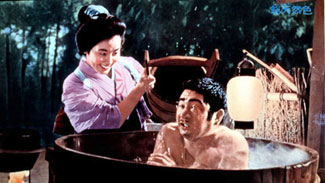 A couple of footnotes on the fourteenth Zatoichi episode: The rights to this film were purchased for Quentin Tarantino, so that for several years it has been missing from the otherwise complete subtitled Zatoichi set as sold in the USA. A couple of footnotes on the fourteenth Zatoichi episode: The rights to this film were purchased for Quentin Tarantino, so that for several years it has been missing from the otherwise complete subtitled Zatoichi set as sold in the USA.
It is not likely Tarantino will ever remake this film, & one can hope the rights will eventually revert so that the original film can be released in the USA.
In the meantime, it has been available in the UK, though you'll need a zone-free dvd player to view the Pal format. It's also available as a zone-free disc through the American "grey" market.
Be aware that there is a UK jewel box set which has a discription of Zatoichi at Large (Zatoichi goyo tabi, 1972) represented as Zatoichi's Pilgrimage, disappointing many an Ichi fan who'd thought they'd finally located the missing fourteenth episode. This error seems likely to be forever perpetuated, having been copied verbatim many places on the worldwide web.
copyright © by Paghat the Ratgirl
|