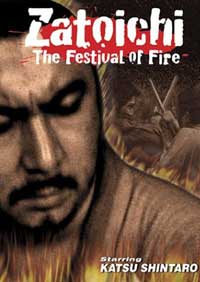
 In the twenty-first feature film about the blind swordsman, Zatoichi's Festival of Fire (Zatoichi abre himatsuri, 1970), Shintaro Katsu's co-star is the great Tatsuya Nakadai. In the twenty-first feature film about the blind swordsman, Zatoichi's Festival of Fire (Zatoichi abre himatsuri, 1970), Shintaro Katsu's co-star is the great Tatsuya Nakadai.
\He plays a jealously psychotic samurai who has murdered his beloved but faithless wife (Kazuko Yoshiyuki) & has set out on a mission of killing every man he believes to have slept with her.
The only man left alive who had ever been involved with her is Zatoichi, who merely assisted her in a moment of need, but the insane samurai will believe no excuses.
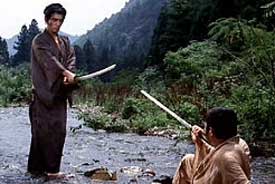
Their first encounter reveals that the always-indestructible Ichi may well have met someone stronger. When the samurai withdraws, it is not because Ichi was winning, but because the insane killer fears he will have nothing to live for once the last man who knew his wife is dead.
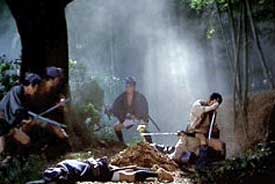
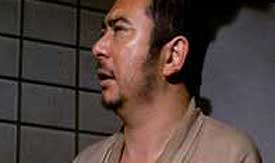 He follows Ichi & watches as several yakuza attack him, & are swiftly cut down, not only the yakuza collapsing on the ground, but also a tree that was in the way of Ichi's swift blade. He follows Ichi & watches as several yakuza attack him, & are swiftly cut down, not only the yakuza collapsing on the ground, but also a tree that was in the way of Ichi's swift blade.
Nakadai's character saunters through a story unrelated to his presence, a threat in the background, providing the promise of a one-on-one duel at the very end.
As he follows Ichi, he'll actually assist him if need be, since he won't permit anyone but himself to experience the pleasure of killing the him.
Yakuza are after Ichi's life but quickly figure out he's not going to be overcome with swords. A woman named Okiyo (Reiko Ohara) whom Ichi met in a gambling hall impressed him hugely. He acquired a gushing shy crush on her.
 She's the daughter of a local gang lieutenant, & though she can smile most winningly with apparent sweetness & gentleness, she's a yakuza at heart & not at all reluctant when it becomes her job to assassinate Ichi. She's the daughter of a local gang lieutenant, & though she can smile most winningly with apparent sweetness & gentleness, she's a yakuza at heart & not at all reluctant when it becomes her job to assassinate Ichi.
She's callously two-faced for a while, pretending to such arch sweetness while intending death to Ichi. But Ichi is so undemanding & affectionate toward her, that she does eventually really fall for him -- as beautiful young women are inclined to do throughout the series, & who can blame them.
By the time Ichi discovers she's his enemy, she is no longer a threat. Still, taking a lesson from the samurai whose excessive love for drove him to insanity insanity, Ichi vows never again to fall in love, & will not forgive Okiyo.
 Another figure out for Ichi's life is a beautiful wakashu or homosexual youth. Another figure out for Ichi's life is a beautiful wakashu or homosexual youth.
Umeji is as pretty as a girl, but admires the yakuza world, & wants to achieve something that will "make me a real man." In his imature world view, seducing Ichi in order to get close enough to kill him will prove his manhood.
The attempted seduction is wonderfully orchestrated, & we can't be sure Ichi wouldn't've had sex with the beautiful young man, but since he drew a knife & tried to kill Ichi, Ichi certainly lost interest. When he chastises the youth, he does not criticize him for being effeminate & homosexual, but for being dishonest, for "A real man has no secrets under heaven!"
 The wakashu is played by a pop celebrity who usually goes by the name "Peter," after Peter Pan, otherwise Shinnosuke Ikehata. The wakashu is played by a pop celebrity who usually goes by the name "Peter," after Peter Pan, otherwise Shinnosuke Ikehata.
He's a television variety show regular, & can be seen in a handful of other films including Hinotori (Phoenix, 1978) wherein in plays a court lady, & in Kurosawa's Ran (1985) in which he plays the great lord's jester.
His character type was a commonplace of the Tokugawa period & "comrade love" between samurai was not stigmatized. But this intriguing aspect of Japanese culture & history is only rarely explored in samurai films as overtly as it is in this episode of Zatoichi.
Comrade love, or homosexuality, is a subliminal component of the majority of classic "chivalrous gambler" yakuza films but only occasionally the overt subject of a samurai movie. So this plot thread lends both originality & authenticity to this episode.
Ichi also meets along the way a comedy relief couple running a roadside inn, trying to assist customers politely while continuously kicking & shoving each other & cursing one another out. This whimsically dysfunctional pair are played by Reiji Shoji & Utae Shoji of a well known family of comedians.
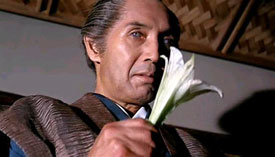
 Set in the Kanto region, the boss of bosses is Yamikubo (Masayuki Mori), a blind man who carries himself with regality & demands to be treated like a daimyo (lord) instead of "walking in shadow" as the yakuza code requires. He's known as "the dark imperior lord" or "the underworld shogun." Set in the Kanto region, the boss of bosses is Yamikubo (Masayuki Mori), a blind man who carries himself with regality & demands to be treated like a daimyo (lord) instead of "walking in shadow" as the yakuza code requires. He's known as "the dark imperior lord" or "the underworld shogun."
There's a great scene in which both blind characters play a "noisy" game of Go together memorizing by sound each others' moves on the gameboard.
They recognize preternatural skills in the other. They have many similarities, but they certainly do not share the same sense of justice & yakuza propriety.
 Yamikubo may pretend to have a capacity for chivalry, but Ichi sees through him. As the story progresses this Boss of Bosses seems increasingly the sociopath, willing even to kill a helpless child. Yamikubo may pretend to have a capacity for chivalry, but Ichi sees through him. As the story progresses this Boss of Bosses seems increasingly the sociopath, willing even to kill a helpless child.
He knows Ichi's strength, & he doesn't like that Ichi disapproves of him, so he sets the various assassination plots in motion not caring how many die, so long as in the end Ichi is led into a fiery trap wherein he can be roasted alive.
As the climactic one-against-all battle approaches, Ichi promises Yamikubo, "I will bring down heaven's judgement on you," standing broad-shouldered & menacing in the dark. But Okiyo, who by now Ichi knows to be duplicitious, is held captive for refusing to kill Ichi.
She will be killed if Ichi refuses to disarm himself. He throws down his sword, but after twenty-one films, we already know this delay tactic won't last long.
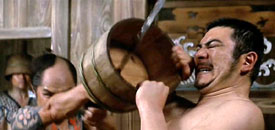 And that final battle makes of Ichi truly monstrous, a ghost-like figure appearing then vanishing in the dark once he starts reaving. And that final battle makes of Ichi truly monstrous, a ghost-like figure appearing then vanishing in the dark once he starts reaving.
With a fine chambara director like Kenji Misumi at the helm, & Kurosawa, Mizoguchi & Shinoda's cinematographer Kazuo Miyagawa behind the lens, it is no surprise that Zatoichi's Festival of Fire is visually one of the finest episodes in the series. It provides everything one expects of a Zatoichi feature.
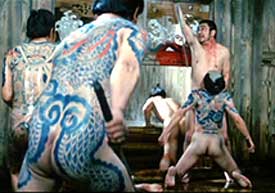
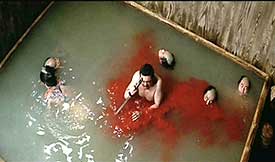
Plus it has a few novel ingredients (like the wakashu or the unusual nude duelling sequence in a bathhouse) to prove the series had not run out of anything fresh. Plus it has characters more deeply drawn than usual.
SECOND REVIEW:
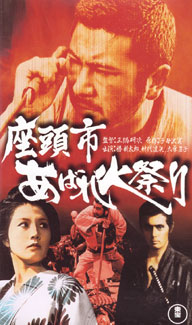 [In mouldering old magazine files I discovered many forgotten film reviews which I had written in the 1970s & early '80s for martial arts & Asian film fanzines. In some of these old reviews, of films seen on big screens in the International District of Seattle, I had quite a different take than when I revisited the same films decades later on dvd. So here's a second review from my younger self in a different mood, with the slightest revisions.] [In mouldering old magazine files I discovered many forgotten film reviews which I had written in the 1970s & early '80s for martial arts & Asian film fanzines. In some of these old reviews, of films seen on big screens in the International District of Seattle, I had quite a different take than when I revisited the same films decades later on dvd. So here's a second review from my younger self in a different mood, with the slightest revisions.]
Tatsuya Nakadai is the impressive co-star alongside Shintaro Katsu in the twenty-first feature film about Masseur Ichi the blind swordsman, Zatoichi's Festival of Fire.
Nakadai plays a seriouisly disturbed samurai attempting to kill everybody who ever knew his wife. Ichi had saved a beautiful woman from "a lecherous bastard" but then failed to save her from her own murderous husband.
Kanto province's arch-oyabun (godfather) Yamikubo is treated in the region like a daimyo or lord, known as "the Shogun of the Underworld," or Dark Imperial Lord (played by Masayuki Mori, one of Kurosawa's regulars). Yakuza are supposed to walk in shadow, & this self-important lordly boss of bosses is most assuredly not adhering to that tradition.
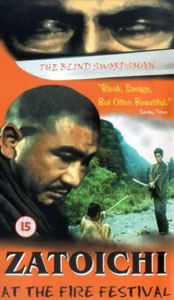 The Dark Imperial Lord happens also to be blind & it seems momentarily that sharing this trait will allow for some sympathy between him & Ichi. But Ichi too soon figures out that the godfather's phony lordliness & pretense of a chivalrous nature poorly disguises how wicked he really is. And this godfather disliking being seen for who he really is needs to destroy Zatoichi at any cost. The Dark Imperial Lord happens also to be blind & it seems momentarily that sharing this trait will allow for some sympathy between him & Ichi. But Ichi too soon figures out that the godfather's phony lordliness & pretense of a chivalrous nature poorly disguises how wicked he really is. And this godfather disliking being seen for who he really is needs to destroy Zatoichi at any cost.
Ichi meets an effeminate perfumed wakashu (homosexual youth) named Umeji, played by transvestite performer "Peter" who can also be seen in Kon Ichikawa's Phoenix (1979) as one of the miscellaneous ladies-in-waiting. Umeji gets a crush on Ichi & though Ichi is not the least offended about the wakashu's forwardness, he's also not all that interested.
Ichi does have a crush on Okiyo (Reiko Ohara), a woman gambler whom the oyabun instructs to get close to the blind swordsman & take advantage of his feelings. She seems sweet, but she is an assassin, & is up front when she admits, "I hate men in general." Yet she eventually realizes she does not hate Ichi.
It is beautifully filmed with unusually brilliant colors, but one of the key scenes is ruined by the Adam West Batman style soundtrack, when Ichi is attacked in his bath & has a naked one-against-all duel. It could've been a very cool sequence if it hadn't been so badly scored in a style that is just so 1970 instead of Tokugawa period. The rest of the soundtrack is excellent & appropriate.
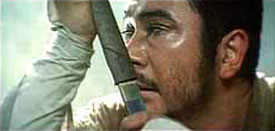 A fairly elaborate trap is set for Ichi by the blind godfather, highlighted by Ichi stranded on a small island in a lake of fire. A fairly elaborate trap is set for Ichi by the blind godfather, highlighted by Ichi stranded on a small island in a lake of fire.
It's a might overblown but it's also undeniably colorful, though the second & more intimate climax with Ichi facing off one on one with Nakada as the psychotic nameless samurai is more credible & emotionally satisfying.
The script is a bit busy & uneven, & some of the humor, like the fart in the bath bit, pretty awful. Katsu co-wrote the script with Kenji Misumi, one of the finer directors throughout the series, & it's a little surprising the episode isn't better than it is, which is not to say it's not a pretty good one. The story in its broad strokes is fairly standard fare in the Zatoichi canon, but the overall look of the film gives it considerable individuality.
The inclusion of a wakashu character is uncommon in samurai films though they were very common in samurai society. There are also a couple fine comic interludes, most especially the butt-kicking domestic spat acted out by comedy duo Utae & Reiji Shoji at a roadside inn. And best of all, Nakadai plays such an incredibly cool psycho samurai that The Festival of Fire has got to be placed fairly high in the "best of" list of Zatoichi features.
copyright © by Paghat the Ratgirl
|