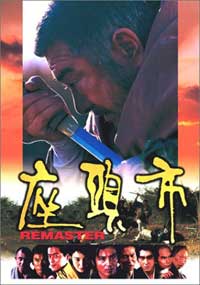
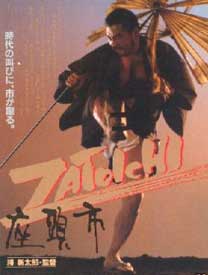
 After a decade away from his most famous character, Shintaro Katsu made one more Zatoichi feature film in 1989. After a decade away from his most famous character, Shintaro Katsu made one more Zatoichi feature film in 1989.
The twenty-sixth Zatoichi featyre opens with the aging Ichi even more humbled & pathetic than when young, clad in filthy rags & forced to slurp spilt soup from a dirty floor.
But as things progress, we'll find him to be a virile old sod still appealing to the most beautiful of women, still able to save babies, girls, & villagers from tumult, still devoted to dicing & wrestling, & most of all, his quickdraw blade is if anything even swifter to slice up bad guys.
The film, as something of a "comeback & farewell" for chambara's most famous underdog hero, strives to be everything in one last film that Ichi stood for in twenty-five earlier feature films followed by four years of the serial television episodes.
This results in a "best of" set of familiar sequences that don't necessarily add up to a cohesive story.
And a tragedy occurred on the set during filming, which darkened Katsushin's reputation. As he was star, producer, & director, he was in complete control of the production, & many could not help but wonder if his drinking & drug use contributed to the ferocious accident.
In an action scene, stuntman Yukio Kato was killed by Katsushin's own son, Ryutaro Gan, a stuntman in training. The young man had been given a real sword & told it was a prop-sword, & sliced through Kato's jugular vein. A police investigation established cause as "professional negligence."
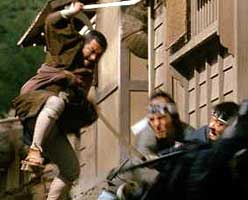 We're introduced to Tsuru, a gentle vagrant gambler who formerly criticized the government & now must stay ahead of the law, living by his wits in the world of wanderers. We're introduced to Tsuru, a gentle vagrant gambler who formerly criticized the government & now must stay ahead of the law, living by his wits in the world of wanderers.
When Ichi is abused by fellow beggars, Tsuru assists him, & promises Ichi that deeds will be done that will improve the lot of poor people. "I will make this a good world," he says. "I'm sure of it."
In the later follow-up of this character, we find him doing the sweetest of good deeds; but he certainly is not changing the world for better or worse. His revolutionary boast that starts off the film had very little to do with the story to be told.
Katsushin's complete control over the project reveals what he loved best about playing this role. Ichi's combination of humbleness, downtrodden pathos, & capacity for monstrousness, are all played to the max.
The humor of the character is subdued but still present. After we've seen Ichi severely whipped in public, we find out that he got in trouble with the law when a magistrate said blind men can't be thieves.
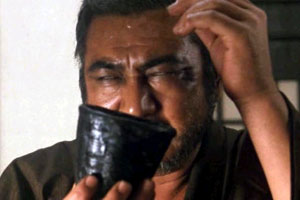 "Who says they can't?" Ichi the blind masseur demanded. "I do," said the magistrate. So Ichi grabbed the magistrate's jutte (a defensive weapon that serves as a law enforcer's badge). "Who says they can't?" Ichi the blind masseur demanded. "I do," said the magistrate. So Ichi grabbed the magistrate's jutte (a defensive weapon that serves as a law enforcer's badge).
The magistrate starts yelling "Thief! Thief!" setting out after the blind scoundrel. Commiserating with a friend later, Ichi decides a good beating like that will keep his old bones from getting stiff.
Ichi has several split-second duels to keep a tone of action throughout, but these duels really amount to Ichi's "swish-swish" & four or five guys falling mortally wounded on all sides as his sword goes back into his cane. This trick, rarely done more than once per film in the 1960s, is done repeatedly here.
The film lacks a central one-on-one duel against someone Ichi must concentrate to defeat, for whom a single back & forth "swish-swish" might not be all it takes. It would seem Katsu was simply too old & overweight to have stamina for any actual duelling sequences.
We are introduced to Ichi's archtypal "potential equal" but he never pays off. He's an oddly endearing ronin-artist Ichi encounters along the road, who becomes greatly enthused over a riceball Ichi shares with him. They immediately like one another, & they have a philsophical discussion about the color red.
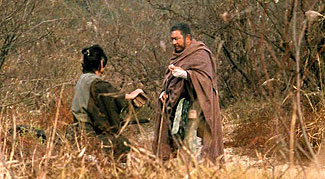 This painter-ronin later becomes a yojimbo bodyguard for the film's worst badguy Tenjin, having displayed his sword skill in a mesmerizing encounter that supplants the gang's former yojimbo. This painter-ronin later becomes a yojimbo bodyguard for the film's worst badguy Tenjin, having displayed his sword skill in a mesmerizing encounter that supplants the gang's former yojimbo.
He's offered a hundred-fifty ryo if he will obtain Ichi's head. It seems the ronin isn't interested in the money, but he does trail Ichi to study his quick-draw technique.
So we know all along this is the guy Ichi will encounter either in an epilog just after killing scores, or immediately before killing scores. That this rather amazing ronin turns out to be as helpless against Ichi as anyone is a real disappointment, though Katsu no doubt intended a minor irony.
Another ingredient is Ichi's gambling. He repeats a stunt we'd already seen in the heyday of series, tricking foolish gamblers into thinking they can cheat a blind man & thereby winning at dice. He is nearly beaten up afterward in Tenjin's gambling house. Before it becomes necessary for him to reveal how dangerous he really is, Ohan the female gambling boss (oyabun), intervenes in Ichi's behalf.
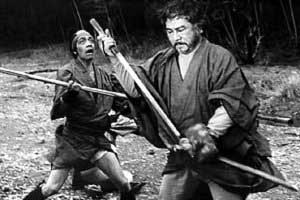 Tenjin is a cruel young oyabun with a scarred face, taking over local territories from aging oyabuns mainly by killing his elders. Tenjin is a cruel young oyabun with a scarred face, taking over local territories from aging oyabuns mainly by killing his elders.
He's also causing grief to peasants. The one gambling boss whose territory he has not been able to influence is that of the tattooed woman, Ohan of the Bosatsu gang.
This beauty boasts on two occasions that she is devoted only to seeing her business intentions come to fruition & does not like men. We're never told what this mission is, but by the end it begins to look like her mission was to induce, permit, or encourage Ichi to kill every bad guy in town, so that her gang could arrive in the aftermath as the region's only powerful gang.
She seduces Ichi in a veritable roman poruno softcore sequence that is delicately, aesthetically orchestrated in a bath. Whether Ichi ever realized his deeds to follow would serve Ohan's mission is never stated, but he well knows she, a self-avowed manhater, has with wonderful abandon given him her virginity, so chances are he is her willing pawn.
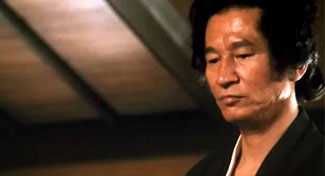 As with every loosely connected ingredient, we don't see much of Ohan, though she certainly is a strong figure in her few scenes. As with every loosely connected ingredient, we don't see much of Ohan, though she certainly is a strong figure in her few scenes.
That women fall for Ichi despite that he's a poor blind vagrant is common in the series, & as we the audience delight in his goodness & menace, it is really no surprise that women should be attracted to such a man.
We've all known some slob who was lucky with the ladies, & it is far more comprehensible that Ichi should be so. But most of his leading ladies have been damsels in distress, & this film features one of those as well.
Yet for once his love-interest is someone powerful who admires & perhaps manipulates Ichi, not someone who needs to be saved by him. He always abandons his lovers too, since as a wanderer he has nothing substantial to offer a woman.
 This time there is never any sense that the woman who seduces him will have even one moment of heartbreak when Ichi continues on his way. This time there is never any sense that the woman who seduces him will have even one moment of heartbreak when Ichi continues on his way.
It's a small change from the usual myth of Zatoichi, but a significant one given that this is Katsu's most personal project.
After a decade to ponder the nature of Ichi's character, the type of women he is involved with appears to be the only thing about which Katsu had new insight; in other respects Ichi's character was redacted into less than before.
Another change may be noticed in the soundtrack. Zatoichi's theme music has been supplanted by something a tad more modern though still with a classic edge. I missed the music that was used throughout the series, but this fresh soundtrack did have interesting components.
The film never quite makes a complete whole of its many ingredients, the connecting factor being less in the plot than in the romanticized extremeness of beauty, violence, & emotion.
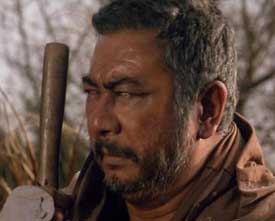 The story moves at a slow pace in order to convey emotional states of characters, yet there is no dearth of action. The story moves at a slow pace in order to convey emotional states of characters, yet there is no dearth of action.
Among the petty assassins Ichi encounters are a group of chanting monks who attack him at an inn.
One of the men has his nose severed by Ichi's flashing sword, & it is flung against the building's central pillar to adhere & slide to the floor. And it's still a long while from the climactic battle.
There's a long pastoral sequence when Ichi stays with a young woman who is caring for lots of children, & who works as a maid in a local inn where she is harrassed for sex.
The pastoral scenes capture the sweetness of Ichi as he interacts with the children & shares in their art lessons. The young woman herself provides the damsel-in-distress required of so many of Ichi's stories.
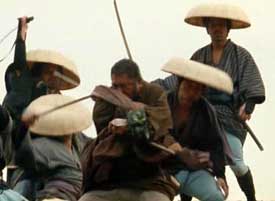
It is all leading up to mass carnage when two yakuza gangs, one massively outnumbered, clash in the middle of the village. When the smaller gang is defeated & only Tenjin's bad guys remain standing, a large wooden barrel comes rolling down the hill with Ichi in it.
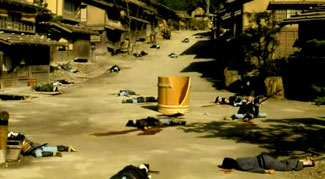 He rolls into their midst & very soon is proving one blind man with a cane-sword can never be overcome. He rolls into their midst & very soon is proving one blind man with a cane-sword can never be overcome.
The extreme familiarity of this enormous one-against-all fight weakens its effect. In some of the classic episodes we really believe such a man as Ichi could exist.
This time we know he'll win because he always does, not because he would do so if such a scenario could actually have occurred.
After he kills everyone, the villagers erupt into song & dance, elated to be liberated from the gangsters.
The streets become as crowded as a festival, as the wearied killer Zatoichi sets out on the road alone.
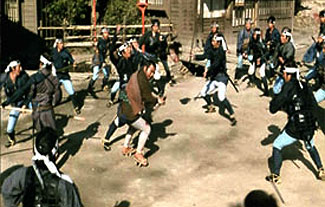 Departed Ichi passes a gang of wanderers who are only just arriving, unnoticed by the happy peasants. Departed Ichi passes a gang of wanderers who are only just arriving, unnoticed by the happy peasants.
These wanderers are the vanguard of the Bosatsu gang belonging to the lady gambler Ohan.
So the villagers will be out from under the thumb of gangsters for a very short while indeed.
There's no sense of finality for the eternal series, & really Katsu's last Ichi episode brought nothing new with which to end this most wonderful series. Rather, with the instant arrival of a new gang, the message here is that nothing much changes in the world.
Yet because he is so much older in the role, the story could've been much different from tales of young Ichi. There should at least have been a confession somewhere along the line that Ichi cannot continue like this in the world, because age will finally slow him down, if not this time, then next time.
Instead, the last image of lonely Ichi on the road seems to imply he never will die, that even if the star of the series drops dead in old age, a new actor like Beat Takeshi will surely arise in order to show us what the immortal Ichi is up to next.
copyright © by Paghat the Ratgirl
|