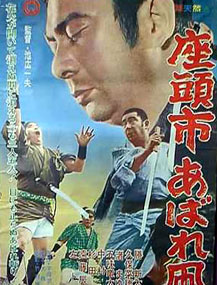
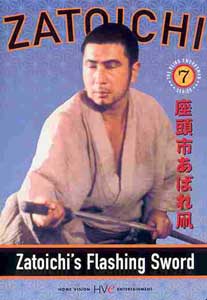
 Spoilers ahead, so see the film first, with this short version of the review to get started: Zatoichi's Flashing Sword (Zatoichi abare dako, 1964) is a good one! Spoilers ahead, so see the film first, with this short version of the review to get started: Zatoichi's Flashing Sword (Zatoichi abare dako, 1964) is a good one!
 On a hot summer day everyone is lazy, though a couple of thieves are pondering whether or not to work up the energy to rob that blind man laying in the corner of the room. On a hot summer day everyone is lazy, though a couple of thieves are pondering whether or not to work up the energy to rob that blind man laying in the corner of the room.
Flies annoy the blind man & with a whimsical warning to the flies, his canesword flashes & flies drop to the tatami mat in halves. The thieves think better of their former plan, & slowly back away.
This episode of the blind swordsman series has plenty of humor, but of a very human sort rather than slapstick, as when the bad oyabun's daughter cheats on paying Ichi his massage fee & he's only paid with some spoiled rice to eat. As soon as he's left alone, Ichi smears the stinking rice all over the kitchen.
 There's loads of serious stuff, too, as when a cowardly young yakuza gunner, Seiroku, shoots Ichi in the back. There's loads of serious stuff, too, as when a cowardly young yakuza gunner, Seiroku, shoots Ichi in the back.
Seiroku is the son of Bunkichi, a village oyabun or boss who is the good guy, & the brother of this episode's leading lady, Kuni (Naoko Kubo). So Seiroku is the black sheep of a decent family.
Ichi is washed away in a stream, & is badly hurt. A passing young woman, Okuni, finds him near the bank amidst reeds, not knowing her own brother was the would-be murderer.
Kuni calls for help. A poor peasant family fishes him out of the water & nurses him. Eating miso in the morning, & full of appreciation that strangers would do so much to save his life, he says, "I guess the world isn't just filled with demons."
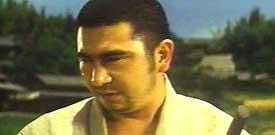 A Zatoichi film needs villains, & Zatoichi's Flashing Sword has more than a few. Five rowdy ronin are in the neighborhood harrassing the weak. These bullies pick on the sensei of a hobby dojo for the sons of farmers who want to learn swordsmanship. A Zatoichi film needs villains, & Zatoichi's Flashing Sword has more than a few. Five rowdy ronin are in the neighborhood harrassing the weak. These bullies pick on the sensei of a hobby dojo for the sons of farmers who want to learn swordsmanship.
They drag Ichi into the hall to tease him, & soon enough experience their come-uppance. One of the ronin stood back from the thrashing the others took, coldly intrigued by the skill of the blind man.
At the same time, some wandering yakuza are after Ichi for killing a gang boss & they will join with the local gangsters for the chance at killing Ichi.
A stuttering evil gambler's oyabun (godfather), Yasugoro of Takeya (Tatsuo Endo), & a corrupt magistrate-intendent collude in their effort to get river-crossing franchise from the good bunkichi. They are intent on controlling the franchise then raising ferry rates unreasonably high when they establish a monopoly.
"Ferry" exaggerates the service at the river's forde. It's actually a shallow crossing & people pay a small coin to be carried on the shoulders of strong men. Zatoichi is a big guy & some amusing moments are had when Ichi offers his patronage to one particular ferry-guy who doesn't want to carry that much weight again.
These sorts of carry-across "ferries" were a historical reality & it's fun to see in this film how such a crossing could impact local economics, no less than would a bridge or a boat service which united two communities.
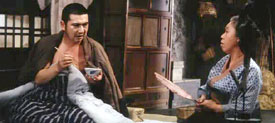 Ichi visits Kuni, the young woman who helped him when he was recovering from the gunshot wound.
Her brother is alarmed that the man he thought he killed is walking around & probably wants revenge. Ichi at first pretends not to realize who Seikichi is, & does in the short run forgive the rotten little would-be gangster, for the sake of the youth's good family.
Her father Bunkichi, the good oyabun, or more of a village headman, has proven to be a helpful patron of the village. But his unaggressive nature has allowed malignant gambling interests to get a foothold immediately across the river.
Bunkichi charges affordable fees for Bon Odori festival concessions. Stuttering Boss Yasugoro wants to take over the ferry traffic, the concessions, everything, not satisfied just running gambling interests on his side of the river.
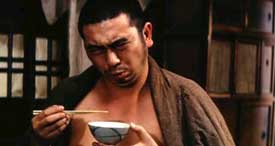 It turns out that Seiroku, the young gunner who shot Ichi, is the son of the Bunkichi, & is the family's black sheep. When he comes home to discover Ichi is staying in his father's house, he's rather worried the blind man will figure out who shot him, but acts innocent in the meantime. It turns out that Seiroku, the young gunner who shot Ichi, is the son of the Bunkichi, & is the family's black sheep. When he comes home to discover Ichi is staying in his father's house, he's rather worried the blind man will figure out who shot him, but acts innocent in the meantime.
He's not the worst possible kid, but seriously misguided about life. By the time Ichi reveals he indeed knows what Seiroko did, the kid has learned a thing or two about life.
Bunkichi as town patron has promised a huge fireworks display during Bon Odori, & has hired the famous Master Kyubei (superb character actor Bokuzen Hidari, who Kurosawa fans will recognize at once) to come to the village & make the fireworks at the edge of town. This old guy is more than half deaf from having spent his adult life setting off explosions.
Kyubei loves his work & plans a remarkable display with fiery effects no one has ever before seen. When Ichi & the old gent become pals, it's quite amusing, a blind man befriended by a deaf man.
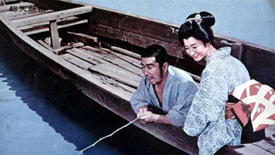 Everyone at Bunkichi's home & headquarters gets along with Ichi so well, they hope he will stay as a member of the household. Ichi, as occasionally happens throughout the series, begins to ponder the possibility of settling down.
Bunkichi's wastrel son pulls one of his badly conceived black sheep stunts & ends up being captured & beaten by the bad guys he hoped to impress. They'll kill him unless Bunkichi signs over concession rights to Yasugoro.
Ichi quietly sets out for the ferry crossing where the youth is held hostage. When Ichi is in the water, gangsters wade out to surround him. Ichi sinks out of sight & cuts them from below, like some monstrous shark. He saves the life of the good oyabun's wastrel son, despite that this was the lousy kid who had shot Ichi.
The troublemaking gang, even with their connections with the corrupt intendent, realize their machinations are apt to be spoiled entirely with a man like Zatoichi around. So they threaten to get Bunkichi in considerable trouble for sheltering a wanted man like Ichi.
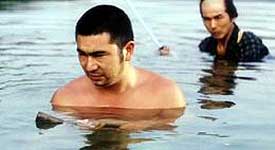 There's a thread of sadness in the story when Ichi, convinced he has at long last found a home where he can settle down, is asked to travel on. There's a thread of sadness in the story when Ichi, convinced he has at long last found a home where he can settle down, is asked to travel on.
In reality Bunkichi just doesn't want him arrested, but won't say it's really the evil gangster boss who wants Ichi gone. So Ichi feels personally rejected by the very patron who'd offered him a home.
Ichi humbly asks Bunkichi, "Can I stay for the fireworks tonight?" for Ichi, even restricted to experiencing the sound of it, had so been looking forward to his deaf friend's display. He's told gruffly, "I said right away!" It makes for a heartbreaking moment.
Master Tengen, the ronin who had earlier been intrigued by the fact that a blind man could fight so well, lay in wait for Ichi outside of town, assisted by the four other ronin.
We'd rather expected that Tengen would be a closer match for Ichi though doomed in the long run of course. The majority of episodes do have one swordsman, frequently a ronin, whose skill is great, worthy of a one-on-one encounter. But as it turns out, Ichi defends himself all too easily against the five masterless samura. Not even Tengen could make much of a showing against Ichi's flashing sword.
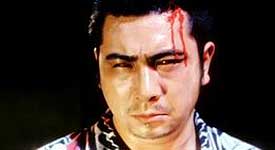 Now that Ichi knows why he was cast out of the place that had begun to feel like home, he obviously has to hurry back for one of those fabulous scenes of carnage that may be rather predictable after so many episodes, but for some of us never grow tiresome.
In this case, he arrives too late, for Bunkichi was attacked the instant Yasugoro heard that Ichi was sent away. Whatever Ichi does now cannot be much help for anyone, but can only be revenge. Vengeance is not Ichi's usual forte, but hooboy, are we in for one hell of an exception.
Ichi looks monstrous when he goes after Stammering Yasu, in frighteningly extreme contrast to the comedic scenes early in the film. "A proper gambler hangs his head & yields his place to honest people," Ichi counselled the stuttering oyabun, but look at what evil the man had done by stepping out of shadow.
When he comes for Yasugoro & the corrupt government official, he wears the summer yukata Kuni gave him to wear for Bon Odori, & reaves through bad guys who never imagined there'd be anyone remaining to retaliate for Bunkichi.
There's quite a moment when Ichi goes through the hallway with his sword cutting down all the mounted candles so that everyone experiences darkness, giving him the advantage. The last candle he holds still burning at the tip on his sword-tip, a trick he does in several episodes.
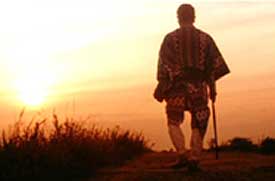 The evil oyabun is not inclined to put up a fight against such a man as Ichi, so won't give Ichi the excuse of self-defense to cut him to ribbons. The evil oyabun is not inclined to put up a fight against such a man as Ichi, so won't give Ichi the excuse of self-defense to cut him to ribbons.
But Ichi is in full monster mode when he growls, "Yasugoro! I never draw my sword first! But I've had all I can take from you!"
The slaughter goes on & on, sometimes in darkness, sometimes lit by Master Kyubei's colorful fireworks.
When the last blood is spilled, Ichi stands in the light of the fireworks display looking scarcely human.
Heroism marred by monstrousness & sadness makes Zatoichi more than a clever commercial series of swordplay movies. Shintaro Katsu as Ichi captures something of a Dark God in his physical presence & prowess.
No shortage of action, there is nevertheless a good helping of quiet & moody scenes as Ichi is allowed to dream of having a real home.
It's not one of the showier episodes, but it's one of the most strongly character-driven, & Ichi's character really is what makes these films not just tolerable variations of a single story told time & again, but welcome excitement with a mythic figure we can really love.
copyright © by Paghat the Ratgirl
|