SPOILERS GALORE
Cruel young Lord Takayuki beheads a riverside refugee fisherman merely to test the quality of his sword. Such was once the prerogative of any samurai, but at this time of history, at the end of the Tokugawa era, it is illegal, not that there's anyone apt to do anything about it. The young lord is the bastard of the Shogun, bitter to be shunted aside as an unofficial son, but full of himself due to his lineage, & does pretty much any vicious thing he wants.
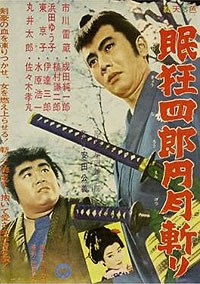
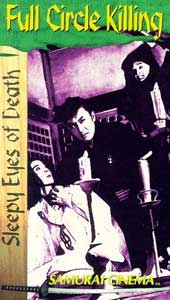
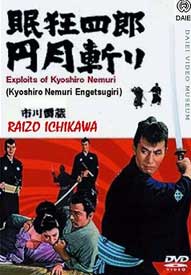
 So begins Nemuri Kyoshiro: Engetsu-giri (1964) which literally means "Kyoshiro Nemuri's Full Moon Cut." It is third in the series circulating in subtitled prints as Sleepy Eyes of Death: Full Circle Killing & as Exploits of Kyoshiro Nemuri the Swordsman. So begins Nemuri Kyoshiro: Engetsu-giri (1964) which literally means "Kyoshiro Nemuri's Full Moon Cut." It is third in the series circulating in subtitled prints as Sleepy Eyes of Death: Full Circle Killing & as Exploits of Kyoshiro Nemuri the Swordsman.
The somewhat dandified elegant wandering swordsman Kyoshiro Nemuri is nearby when Lord Takayuki murders the fisherman. The riverside community momentarily thinks he is the cruel lord's accomplice. So he reveals that he has in his sheath only a bamboo sword, which startles the peasants.
It turns out his sword is at a refurbishers. When Kyoshiro arrives to reclaim his sword, the refurbisher is eager to be rid of it. "I just can't bring myself to like it," he explains. "It emanates evil, as though it is accustomed to killing" (the 35 mm print translates it differently than on the dvd: "It emanates evil. It thirsts for blood").
His sword's name is "Muso Masamune" & throughout the series his weapon is frequently recognized as the work of the great swordsmith Masamune, a surprising treasure for a ronin to possess. The "personal" name of the Masumune sword is "Muso" which means "Heartlessness." As a samurai's sword is a reflection of his soul, when the sword refurbisher says "it emanates evil," this is a statement also of its bearer.
Konami, a beautiful messenger, comes to the inn to fetch Kyoshiro to a furtive meeting. He's not usually that easily commanded to do anything, but this is his opportunity to insult the murderous young lord & lop off his best iai practitioner's arm in a quick-draw match. This hardly endears him to the shogun's bastard who had wanted to offer Kyoshiro employment.
 It appears that Lord Takayuki may be assassinating other sons of Shogun Ienari, or else someone is doing so in his behalf. It appears that Lord Takayuki may be assassinating other sons of Shogun Ienari, or else someone is doing so in his behalf.
Meanwhile Tajuu, the gimpy slow-witted son of the slain fisherman, kidnaps a samurai child hoping to get revenge on his father's killer. Kyoshiri forces the riverside community to return the innocent child, but promises to help Tajuu get revenge.
At a critical moment in the story, Kyoshiro will allow himself to be captured & disarmed in order to save the riverside refugees, including Tajuu. But not everything Kyoshiro does is so unambiguously heroic, as he is a rogue to the core.
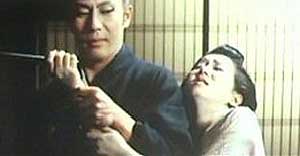
Showing the decidedly sexist aspect of his character, Kyoshiro will use his old trick of undressing Konami with his sword in order to humiliate her. She is betrothed to young Lord Takayuki, despite that she is not of samurai origin. She is at least beautiful & her parents are wealthy, useful in the conspiracy to make a bastard the next shogun. She is haughty & proud due to her allience with the cruel Takayuki, exactly the kind of woman Kyoshiro is prone to defiling.
She in response to her experience hires a leading swordsman to assassinate Kyoshiro. This samurai is a throwback to noble times. He takes the job only to pay a debt of honor to Konami's family. He is also simply curious to match his sword to Kyoshiro's & see if he cannot penetrate the reputedly undefeatable Full Moon Cut.
Kyoshiro feels no enmity toward this man & indeed is impressed with his old-fashioned sense of what it means to be a samurai, even though what Kyoshiro tells him is, "Samurai are pitiful." Kyoshiro starts his Full Moon sweep slowly, with the expected result, & Kyoshiro has a look of sadness when the deed is done.
 To call Kyoshiro a misogynist or at the very least sexist is not to malign him. It is simply integral to his character, & he's an anti-hero after all, not a goody-two-shoes sort of heroic type with 20th Century liberal values. To call Kyoshiro a misogynist or at the very least sexist is not to malign him. It is simply integral to his character, & he's an anti-hero after all, not a goody-two-shoes sort of heroic type with 20th Century liberal values.
As played by Raizo, Kyoshiro is so sexy & appealing that it can be disturbing to watch his behavior with women if the viewer has mistaken him for purely a hero.
Barring a personally masochistic erotic response to the sexy actor, the reason a feminist might enjoy this fictional character is because his creator deeply understood his warped character. Thus his relationships with women are no less twisted than his relationship to society or his dangerousness to fellow alpha males.
Sexists tend to think of women in terms of purity or harlotry with no in-between, & Kyoshiro is not much different, except that he judges women by their character so deeply from his point of view that a harlot can be pure while a proud virgin may at heart be a whore. Or such could be his judgement, & he could well be right.
He has been having an affair with Okita, whose husband was sent to the prison island of Sado, from whence the man was expected never to return. So she felt at liberty to fall in love with Kyoshiro, who by no means mistreats her, for he admires her character.
But her husband was released under the condition that he murder Kyoshiro, whose enemies are increasing in number. Kyoshiro is getting a little peevish, resentful that he is cornered into killing underlings he has no reason to despise. It's the top dog he'd rather kill.
In the lengthily action-intense climax, bad Lord Takayuki gets all his warriors together to kill Kyoshiro Nemuri, a night attack by torch light on the river's bridge.
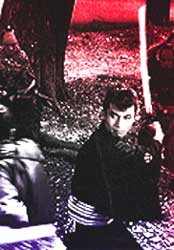
We are treated to an extremely well-staged one-against-all battle on the burning bridge; we witness Kyoshiro's arrow-deflecting skill; we see the bridge's fiery collapse with Kyoshiro on it, only to see Kyoshiro stride tall from the inferno. Finally the cruel young lord cannot avoid the one-on-one match, with a close-up view of the Full Moon Cut.
 This is the best of the first three episodes, but Daiei Studios was still being conservative about how they would allow the character to be presented. This is the best of the first three episodes, but Daiei Studios was still being conservative about how they would allow the character to be presented.
So in these first three films, Kyoshiro had reddish hair just like the character of the stories, but the scripts are careful not to say why. He was permitted to be quite the sexist antihero but the dark, dark, dark context for his streak of malice is nowhere explicitely stated. Daiei Studio seemed just a little tentative & fearful about how to convey the character.
The series did not gain the theater audience the studio expected, & was nearly abandoned as a series. When the fourth film in the series was in the planning stage, it was understood that if it did no more box office than the first three, then there would never be a fifth film.
This is why with the fourth installment, the floodgates of Kyoshiro's strangeness were unleashed, almost in desparation to save the series. At last a director will be dealing with Kyoshiro's mother's rape by a European priest at a Satanic mass & her subsequent suicide, giving context to his cynical nature, his exoticism, his issues with women, & his love/hate relationship with oppressed underground Christians.
When at last the edgiest aspects of his character were no longer sanitized, the public would respond so favorably that the series would become a huge hit, & Kyoshiro would be Raizo Ichikawa's signature role for the rest of his career.
SECOND REVIEW
 [I reviewed this film in the 1970s for a fan publication & only recently stumbled upon a copy of that. The following, with minor corrections, is my former "take" on this episode, after having seen it at the beloved & long lamented Kokusai Theater in Seattle on a very big screen, while seated under a damaged ceiling that was destined one day to collapse onto the seating era:]
In the 1830s, loyalty & duty ahve become almost non-existent among samurai. Kyoshiro Nemuri wanders about the land being much above it all, disgusted by everything. In many episodes Kyoshiro is no better, if not worse, than anyone else. But in The Exploits of Kyoshiro Nemuri he is much less stridently an "anti" hero & reveals a chivalrous sprit.
A Shogun's bastard & his the unrecognized prince's bitter mother are conspiring to kill all shogunate heirs, so that the cruel & unruly prince can become top dog in Japan. In opening shots, the bastard prince enters the more-or-less permanent encampment of outcastes & lowlky streetwalkers along a dried riverbed, & for the sake of testing his sword, severs the head of an old man.
He then departs, unconcerned with the old man's somewhat retarded son who is left wailing & hugging his father's head, stuttering & vowing an unlikely vengeance. Kyoshiro, though despised by the outcastes as just another of those damned samurai, is moved by their plight, & conspires against the evil prince who, by slow stages, is made to seem not merely evil but profoundly misguided by his wicked mother; he's just basically a wretched messed up young man.
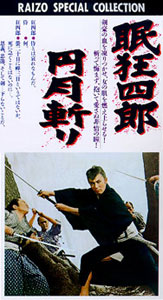 The bastard lord is also desirous of possessing Muso Masamune, which is the name of Kyoshiro's famous sword. This adds a plot complication, but essentially this whole story is telegraphed from the start with very few twists or turns leading to the obvious conclusion. The bastard lord is also desirous of possessing Muso Masamune, which is the name of Kyoshiro's famous sword. This adds a plot complication, but essentially this whole story is telegraphed from the start with very few twists or turns leading to the obvious conclusion.
Along the way, Kyoshiro rapes the prince's girlfriend just to teach her a lesson, & because Kyoshiro is just generally a shit when it comes to women. That he is even a rapist is fundamental to his personality, & usually he seems incapable of love.
But this particular episode overall presents Kyoshiro as avenging angel, not as self-serving as he would ordinarily be, & he'll even prove capable of honest affection & friendship with one woman.
This is an apparent contradiction in his character, both within this episode in particular, & for the overall series. He isn't invariably bad to women; rather, he is narrowly judgemental & those which cannot pass muster he rapes or kills or otherwise punishes.
A purer woman -- judged by the nature of her spirit rather than virginity or anything so trite as that -- he may assist. But deep friendship? Or falling in love? Not likely. In the whole series he probably only fell in love twice, unless one's idea of love is very loosely defined. He's totally in character raping the prince's girlfriend.
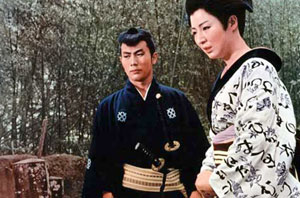 Yet for once he has a meaningful relationship. She is the wife of a criminal who is never going to be allowed to return from Sado, the prison island. Yet for once he has a meaningful relationship. She is the wife of a criminal who is never going to be allowed to return from Sado, the prison island.
Numuri has compassion for her guilty feelings about being an unfaithful wife. He tells her that if she ever betrays him personally, for the sake of her husband, he won't resent it.
With this heroine, he has lost all the sexual arrogance that keeps him distant even from women he doesn't dislike. I can't think of even one other episode in which he develops such a close & personal relationship with a woman.
When her husband is unexpectedly sent home from the prison island, it is not Kyoshiro who will be betrayed by the wife. Her husband is an assassin, who uses small hanafuda cards like shurikens, & he was only freed on condition that he use his skill to kill Kyoshiro. This doesn't work out so well for him & after his funeral, his widow is deeply ashamed of her role, caught as she had been between duty to one man, & love for another. In consequence of her unfaithfulness, she vows never to see Kyoshiro again, & he's genuinely sad about the course of events.
Although there's little in this film to set it apart from others in the series, one interesting aside is the interjection of a samurai convinced, by the raped mistsress of the bastard prince, to attempt revenge in her behalf. This middle-aged samurai had lived an exemplary life & takes on the task out of a sense of duty, making him a clear-cut exception in a corrupt world, the rare sort who passes muster under Kyoshiro's judgemental gaze.
Kyoshiro is so impressed by the man, he tries to talk him out of the duel. He had lived his whole life in poverty, without favor, & here he was willing to lay his life on the line for what he perceived as a just cause, without hope of reward. He will not waver from his attempt, & the duel is one of the most most tragic of Kyoshiro's experience.
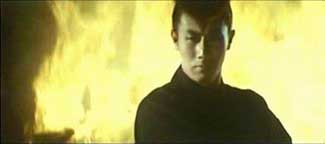 Usually his opponents are dispatched, never to be considered a second time. But for once, Kyoshiro will revisit the site of a duel, still lamenting the demise of a rare good man. Usually his opponents are dispatched, never to be considered a second time. But for once, Kyoshiro will revisit the site of a duel, still lamenting the demise of a rare good man.
Raizo Ichikawa does some of his finest chambara swordfighting in this episode. If the episode had had nothing else going for it -- & his has plenty -- it would be rewarding just for the visual stunts & duels. The final scenes of carnage & revenge are certainly not unexpected, but damend well done.
In the coda, ninja spies come out of the woodwork to inform Kyoshiro that they were aware of the prince's villainy & they had used Kyoshiro to purge the family of a black sheep. This has the effect of deadening the initial theme of Kyoshiro personally deciding to to champion the meek.
copyright © by Paghat the Ratgirl
|