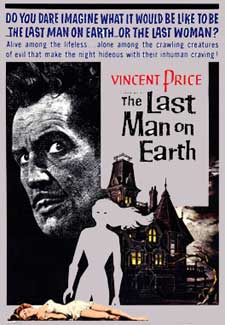
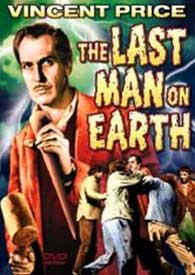
 Almost pastoral in its pacing, Vincent Price is The Last Man on Earth (1964). He walks through the empty world by day scavenging for survival needs, & holds up in his garlic-protected rambler home while zombie-like vampires come out of hiding to prey upon the weakest among their own kind, or stagger about outside his protected home calling, "Morgan! Come out Morgan!" but otherwise having only limited reasoning capacity.
A plague wipes out civilization & the survivors have a vampiric thirst. In flashbacks we are informed of the science fictional bases for vampirism, Morgan's role in doomed research into a cure, & the loss of his family & everything in the world that he once loved. He alone is naturally immune.
Though cheaply made & poky, Price gives his role sufficient depth that the film is attention-holding. It's more about Morgan's emotional states than about incidents or action involving the vampire-zombies.
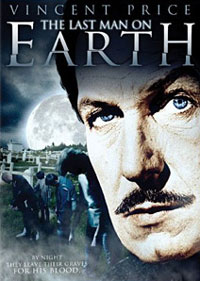 It is interesting to see how close the zombie vampires are in make-up & body posture to those of George Romero's Night of the Living Dead (1968), the influence on Romero being unquestionable. It is interesting to see how close the zombie vampires are in make-up & body posture to those of George Romero's Night of the Living Dead (1968), the influence on Romero being unquestionable.
Although Romero did not originally call his reborn ghouls "zombies," nor did Corman's film, these films nevertheless became the major inspiration for the great explosion of zombie films in the decades to follow & right up to today. Though Romero's film was foremost in this influence, his film's influence from Last Man is undeniable.
[SPOILER ALERT] In the action-ending of Roger Corman's The Last Man on Earth, a hitherto unrevealed group of people infected but not completely transformed hunt down Morgan & kill him. He had become famous among the semi-survivors of the plague because he'd been hunting vampires in their daytime sleeping places, never realizing he was also killing members of the small community that had not entirely turned.
The further implication here is that an actual cure available through Morgan's antibodies is lost; but a new race of mutants will survive & persist. This ending did not appeal to the creative team for the remake, Omega Man (1971) starring Charleton Heston as the last man on Earth, his antibodies having a much more direct impact on the plot. [END SPOILER ALERT]
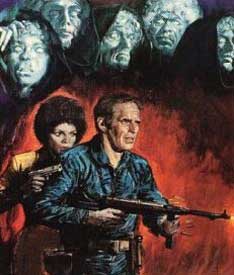 Though the Price film is satisfactory for such a cheapie, the remake tells a better story with more exciting action & vastly higher production values. Both films are based on Richard Matheson's classic I am Legend (1954) which frames the classical vampire theme in a science fiction context. Though the Price film is satisfactory for such a cheapie, the remake tells a better story with more exciting action & vastly higher production values. Both films are based on Richard Matheson's classic I am Legend (1954) which frames the classical vampire theme in a science fiction context.
In The Omega Man, Heston is the same kind of scenery-chewing over-actor as was Vincent Price, but with the added bonus of being a hunk suitable to the action of the piece, therefore much more is made of Heston as a vampire slayer.
Heston's "trilogy" of brilliant-of-kind science fiction epics are Soylent Green (1973), the first Planet of the Apes (1968), & The Omega Man. In each he uses his body like the God of Silent Film Mime to create a totally over-the-top screen presence, then adds his phony-angst baratone like the God of Shakespearean Frauds.
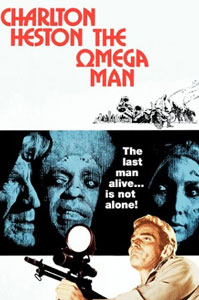 His style is one of a kind & in its own way naturally brilliant. He is certainly a glory in any film that requires excesses, whether as Moses, Ben Hur, or Robert Neville the last machine-gun toting vampire-slaying dude on Earth. His style is one of a kind & in its own way naturally brilliant. He is certainly a glory in any film that requires excesses, whether as Moses, Ben Hur, or Robert Neville the last machine-gun toting vampire-slaying dude on Earth.
Many noticed the similarity to Night of the Living Dead (1968) but only folks who'd seen Last Man on Earth realized the influence was Roger Corman on Romero, not Living Dead on Omega Man.
In its day Omega Man seemed like a brilliant work of science fiction (& Matheson's novel really is brilliant). The decades haven't been kind to it as the look of Omega Man is so clearly not the future, but 1971, from the leading man's jogging tights to the leading lady's afro.
But allowing for a few scenes that come off campier today then they did when the film was new, it's still an exciting well done film. Since the film is set in the very near future of 1976, it could even be viewed today as set in an alternative past, & the fashions remain appropriate for the place & time.
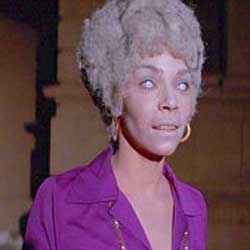 Robert Neville has built himself a fortress impenetrable to the night's hordes of zombie-vampires. Robert Neville has built himself a fortress impenetrable to the night's hordes of zombie-vampires.
By day he hunts them in their lairs & kills them as they sleep. There is genuinely nobody else on the planet not infected by the Apocalypse of germ warfare. But there are a few remaining who have not yet gone all Zombie, though eventually they all do.
Robert falls in love with a beautiful young woman (Rosalind Cash) who has not yet Turned. It's strange to realize their love-making scene was the first on-screen black/white kiss in science fiction film history. That she likes to be on top is kinda cool.
The issue of racism & black power is developed in the film, so that it seemed rather radical in its day. Although the style of Black Power Politics is cartoony & dated now, unfortunately the issues still apply to American society. And it's unfortunately easy to believe this issue will still apply after the Apocalypse.
The omega man's goal in life becomes not merely to eradicate vampire kind, but to produce enough serum from his own immune system's antibodies to cure the tribe of the untransformed before it's too late for them & thus for all humanity.
The brutally heroic ending I won't describe, but it still gets to me as slightly awesome, & surprisingly emotional for something constructed from so much artifice & overacting.
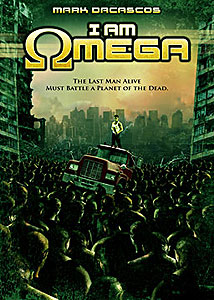 The director's name Griff Furst reads like a confession of "Grift First, worthwhile movie never." I Am Omega (2007) is a hokum-ridden plagiarism of Richard M. Matheson's 1954 novel. It goes so far as to mix the the titles of the legal adaptations, Charlton Heston as Omega Man & Will Smith in I Am Legend (2004).
The familiar tale follows the adventures of a man immune to the virus that turned most of humanity into cannibalistic mutants who look like skinless guys covered in mildew & pizza sauce.
It pains me to admit it of a rip-off, but these zombies are no dumber than the ones Will Smith battled. The film is otherwise labored & awful. The script is especially bad, which is surprising since all they needed to do was keep plagiarising. And though the world has in essence come to an end, you'd be surprised how clean & tidy a post-apocalyptic New York remains.
Our hero is renamed Renchard, & his main mission in life is killing zombies through the wasteland of New York city. Though they're never explicitely called zombies, they're zombies. The primary means of fighting zombies is with kung fu, karate weapons, & guns.
Bad as it is, still, it has a full measure of action & for an Asylum knock-off imitation of a better movie, it has entirely competent photography, so is by no means the worst thing Asylum has foisted onto the public.
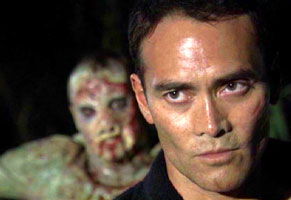 Different from the novel & the official film adaptations, the infected are not restricted to night roving, making the videography easier since it can be bright of day.
Renchard is played by exotic, handsome Hawaiian Mark Dacascos who seems to be utterly talentless in this movie (except at kung fu), but I swear to god I've seen him do better work than this.
For instance, there was nothing wrong with his recreation of the character of Eric Draven for the television series The Crow: Stairway to Heaven (1999). So I'm still blaming the Grift First, Good Movie Never guy.
There's a bizarre subtext that's hard to believe was accidental, & yet it remains too undeveloped to have been intentional. Renchard is apparently immune to the virus due to his random mixing of prescription drugs, a never-stated possibility but man does he like meds. It could well be that Renchard lives in a hallucinatory, drug-addled, schizophrenic state.
This would explain why the city remains clean, the electrical grid & world wide web are still working, & zombies appear & disappear at random. He can't see living people because he's crazy, not because they aren't there. Ah, but no, not possible a film this bad packed anything that subtle into the subtext. It's just me trying to impose logic on an illogical film.
copyright © by Paghat the Ratgirl
|